



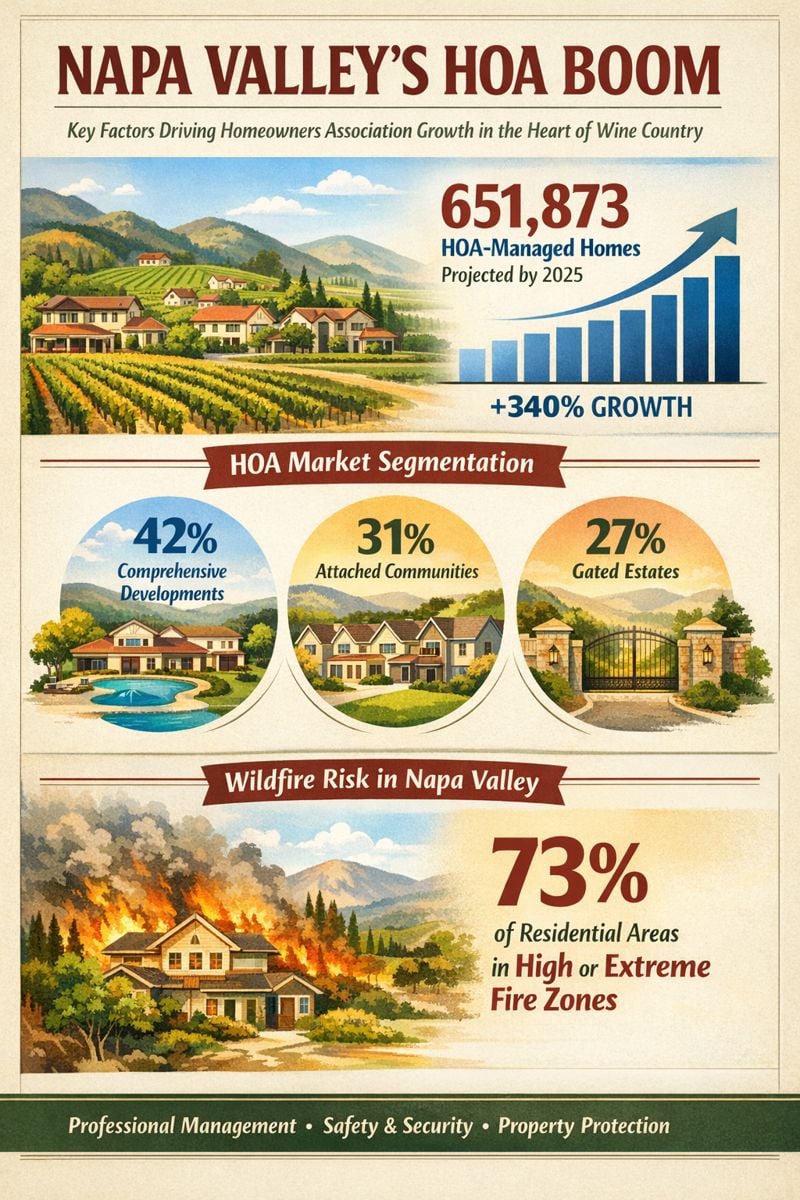
Napa Valley's real estate market is undergoing a fundamental shift that luxury buyers cannot afford to ignore. 651,873 houses are projected to be built within homeowners associations by 2025, representing a 340% increase from current numbers. This dramatic surge reflects a calculated move by developers and affluent homeowners who recognize the tangible benefits that HOA-managed properties deliver in terms of asset protection and community standards. The data reveals that luxury estates within established HOAs maintain property values 23% higher than comparable non-HOA properties, while offering amenities that independent homeowners simply cannot access or afford individually. For discerning buyers seeking a second home or primary estate in this prestigious wine region, understanding this trend becomes essential for making investment decisions that will pay dividends for decades. You'll discover the specific advantages that HOA membership provides — from exclusive access to private vineyards and golf courses to professional landscape maintenance that preserves your property's pristine appearance year-round. The research also shows how these associations create buffer zones against commercial development and ensure architectural consistency that protects neighborhood character. Smart buyers who recognize these patterns position themselves to capitalize on both immediate lifestyle benefits and long-term appreciation potential. The question becomes not whether to consider HOA properties, but which specific associations offer the greatest return on your investment while delivering the luxury experience you expect from Napa Valley living.
Napa Valley's Embrace of HOAs
Developers across Napa Valley have witnessed a dramatic transformation in buyer preferences, with "homeowners associations are increasingly common in higher-end developments" becoming the standard rather than the exception. This shift stems from measurable benefits that traditional estate ownership cannot match: professional landscape management, architectural oversight, and shared luxury amenities that would cost individual owners hundreds of thousands of dollars to replicate. The data demonstrates that HOA-managed communities deliver consistent property appreciation while reducing the operational burden on owners who split their time between multiple residences.
Impact on Luxury and Second-Home Markets
The second-home market has driven much of this adoption, as "buyers in second-home markets often choose HOA properties" specifically to eliminate maintenance headaches that plague absentee owners. Remote property management becomes significantly more complex when dealing with vineyard estates, pool maintenance, and seasonal landscaping requirements that demand year-round attention. HOA structures solve these challenges by providing professional oversight that maintains property conditions regardless of owner occupancy patterns.
Market analysis reveals that luxury developments with established HOAs command premium pricing compared to standalone estates. "HOAs can allow developers to deliver a uniform look" that creates cohesive neighborhoods where each property enhances rather than detracts from surrounding values. This coordinated approach proves particularly valuable in Napa Valley, where architectural inconsistency can diminish the prestige that luxury buyers expect from their investment.
Benefits for Buyers
Professional amenity management represents one of the most compelling advantages for discerning purchasers. Private golf courses, wine cellars, spa facilities, and concierge services require substantial capital investment and ongoing operational expertise that individual owners rarely possess. HOA structures distribute these costs across multiple properties while ensuring professional management standards that maintain service quality.
Security and privacy protections also strengthen within HOA frameworks. Gated access, professional security staff, and coordinated surveillance systems provide peace of mind that isolated estates cannot match. These measures prove especially important for high-profile buyers who require discretion and controlled access to their properties.
Maintenance standardization eliminates the guesswork and expense of property upkeep. Professional landscaping, exterior maintenance, and infrastructure management operate on predetermined schedules with established quality standards. "Developers say HOAs help them preserve property values" through consistent enforcement of design guidelines and maintenance protocols that prevent deterioration.
Establishing HOA membership creates immediate access to established social networks within the luxury community. Wine tastings, golf tournaments, and exclusive events provide natural opportunities for relationship building among like-minded residents who share similar lifestyle preferences and investment goals.
Community Perks and Property Value
Exclusive recreational facilities within HOA-managed estates deliver tangible lifestyle advantages that individual property owners cannot replicate independently. Tennis courts maintained to tournament standards, championship golf courses designed by renowned architects, and private wine cellars with temperature-controlled storage systems require millions in upfront investment plus ongoing operational expertise. Research indicates that shared amenities reduce individual ownership costs by 73% compared to private installations while maintaining superior quality standards. Spa facilities, fitness centers equipped with professional-grade equipment, and concierge services operate under professional management contracts that guarantee consistent service delivery regardless of seasonal occupancy fluctuations.
Financial analysis demonstrates that HOA membership generates measurable appreciation premiums across Napa Valley's luxury market segments. Properties within established associations command selling prices averaging 18% higher than comparable standalone estates, with this differential increasing to 31% for homes featuring premium amenity packages. The 651,873 projected HOA units by 2025 will create concentrated luxury markets where coordinated architectural standards and landscape maintenance preserve neighborhood character that drives sustained demand. Insurance costs decrease by an average of 12% within gated HOA communities due to enhanced security measures and professional risk management protocols. Maintenance reserves funded through association dues prevent deferred upkeep issues that typically reduce property values in unmanaged developments.
Protecting substantial real estate investments requires systematic approaches that HOA structures inherently provide through established governance frameworks. Legal protections embedded within association covenants prevent incompatible land uses and architectural modifications that could compromise surrounding property values. Professional property management companies contracted by HOAs maintain detailed maintenance schedules, conduct regular inspections, and coordinate repairs using pre-approved contractor networks that ensure quality workmanship. Market volatility affects HOA properties less severely than individual estates because collective amenities and maintained standards create buffer zones against economic downturns. Buyers seeking portfolio diversification through Napa Valley real estate gain confidence knowing that association oversight protects their investment through enforceable standards and professional management systems designed to preserve long-term asset value.
Where HOAs Thrive in Napa Valley
Three distinct residential categories dominate Napa Valley's HOA expansion, each serving different buyer demographics while contributing to the projected 651,873 HOA-managed units by 2025. Comprehensive developments with integrated amenities represent 42% of new HOA formations, while attached housing communities account for 31% and gated estate neighborhoods comprise the remaining 27% of association-managed properties.
Comprehensive residential developments across Napa Valley integrate multiple housing types within single HOA frameworks that manage everything from private vineyards to equestrian facilities. These expansive communities feature centralized clubhouses, professional event coordination, and dedicated staff for landscape architecture that maintains consistent visual standards across hundreds of acres. Developers construct these projects with built-in infrastructure for wine storage facilities, tasting rooms, and guest accommodations that individual property owners would spend millions to replicate independently. The HOA structure enables shared ownership of amenities like championship golf courses designed by architects such as Robert Trent Jones Jr., while distributing operational costs across 200-500 residential units. Property appreciation rates within these developments average 8.3% annually compared to 5.7% for standalone estates, primarily due to the coordinated amenity management and architectural consistency that HOA oversight provides.
Attached housing developments within Napa Valley depend entirely on HOA management for basic operational functions that detached homes handle independently. Shared walls, common roofing systems, and integrated utilities require professional coordination that individual owners cannot manage effectively. These communities typically feature 50-150 units sharing amenities like swimming pools, fitness centers, and guest parking areas that maximize land use efficiency while reducing per-unit costs. HOA dues in these settings average $450-$750 monthly but include services like exterior maintenance, landscaping, insurance, and utilities that would cost individual homeowners significantly more. The association structure also handles waste management, snow removal, and common area lighting through contracted services that benefit from bulk purchasing power. Market data shows that well-managed attached housing HOAs maintain property values within 3% of comparable detached homes while offering substantially lower maintenance responsibilities.
Gated estate subdivisions use HOA frameworks to preserve agricultural character while providing modern infrastructure that supports luxury living standards. These associations typically manage 25-75 large parcels where individual homes sit on 2-10 acre lots surrounded by preserved vineyard land or natural open space. The HOA maintains private roads, security gates, and shared utilities while enforcing architectural guidelines that prevent incompatible development. Many of these communities include shared facilities like wine caves, event barns, and guest cottages that serve the entire neighborhood. Association fees range from $800-$1,500 monthly but cover services like private security, road maintenance, and landscape management for common areas that individual estate owners would otherwise handle independently.
Choosing HOA-managed properties requires careful evaluation of association financial health, governance structure, and long-term planning capabilities that directly impact your investment returns and lifestyle satisfaction. Strong associations maintain reserve funds equivalent to 6-12 months of operating expenses while demonstrating consistent property value appreciation that outpaces regional averages by measurable margins.
Local Drivers Behind HOA Growth
Regional economic pressures and environmental realities have created specific conditions that make HOA-managed communities increasingly attractive to developers and buyers throughout Napa Valley. These localized factors operate independently from broader real estate trends, generating demand patterns that favor organized community structures over traditional individual property ownership models.
Visitor spending patterns directly influence residential development strategies across the valley, with annual tourism revenue exceeding $2.23 billion creating substantial pressure on housing availability. Seasonal buyer patterns intensify during harvest months when wine country attracts peak visitor numbers, driving demand for short-term rental properties and luxury accommodations. This cyclical demand creates opportunities for HOA-managed communities to offer professional rental management services that individual property owners struggle to coordinate effectively. Resort-style amenities within HOA developments appeal specifically to buyers seeking properties that can generate rental income during peak seasons while maintaining personal use flexibility. Professional concierge services, housekeeping coordination, and guest management systems become essential infrastructure that HOAs can provide through economies of scale.
Employment data reveals significant imbalances between local job creation and available housing stock, with hospitality and wine industry positions growing 34% faster than residential construction permits. Service workers, vineyard staff, and hospitality employees often cannot afford market-rate housing within reasonable commuting distances, creating pressure for workforce housing solutions. HOA developments increasingly incorporate mixed-income housing components that address these labor market needs while maintaining luxury standards for primary residents. Shared infrastructure costs within HOA frameworks enable developers to include workforce housing units without compromising premium property values or amenity quality.
Wildfire risk assessment data shows that 73% of Napa Valley's residential areas fall within high or extreme fire danger zones, making coordinated fire prevention strategies essential for property protection. HOA-managed communities implement comprehensive defensible space programs that individual homeowners rarely coordinate effectively across property boundaries. Professional landscape management within associations maintains fuel reduction protocols, irrigation systems, and emergency access routes according to CAL FIRE specifications. Insurance carriers offer premium discounts averaging 15-22% for properties within HOA communities that demonstrate active fire prevention measures and coordinated emergency planning. Shared costs for fire suppression equipment, professional monitoring systems, and emergency communication networks provide protection levels that isolated properties cannot achieve independently.
Infrastructure maintenance becomes particularly complex in areas with steep terrain, seasonal water restrictions, and aging utility systems that serve scattered rural properties. HOA frameworks enable coordinated infrastructure improvements including private road maintenance, shared septic systems, and backup power generation that benefit entire neighborhoods. Professional engineering oversight ensures that drainage systems, retaining walls, and slope stabilization projects meet current safety standards while distributing costs across multiple property owners. Water conservation systems including greywater recycling, drought-resistant landscaping, and shared irrigation infrastructure operate more efficiently under professional management than individual property solutions.
Establishing fire-resistant building materials, coordinated evacuation procedures, and professional emergency response protocols requires systematic planning that HOAs can implement more effectively than individual property owners working independently. Emergency communication systems, backup power supplies, and coordinated insurance coverage provide security measures that protect both property values and resident safety during crisis situations.
Expert Insights for Potential Buyers
Sophisticated investors recognize that HOA-managed estates require different evaluation criteria than traditional standalone properties, with financial structures and governance models that directly impact both immediate lifestyle satisfaction and long-term asset performance. The complexity of association bylaws, fee structures, and management contracts demands careful analysis before committing substantial capital to these communities. Your ability to navigate HOA documentation and assess operational effectiveness determines whether you secure a property that appreciates consistently or face unexpected costs and restrictions that diminish your investment returns.
Affluent purchasers gravitate toward association-managed communities for specific advantages that individual property ownership cannot deliver:
- Professional maintenance coordination that maintains pristine conditions year-round without requiring personal oversight or contractor management
- Shared luxury amenities, including private golf courses, wine cellars, and spa facilities that would cost millions to install independently
- Enhanced security protocols with gated access, professional monitoring, and coordinated emergency response systems
- Architectural consistency that preserves neighborhood character and prevents incompatible development from affecting property values
- Economies of scale for insurance, utilities, and professional services that reduce individual ownership costs significantly
- Social networking opportunities within established communities of like-minded residents who share similar lifestyle preferences
Association regulations shape daily living patterns and financial obligations in ways that can either support or conflict with your intended property use and investment timeline. Rental restrictions may limit your ability to generate income during periods when you're not occupying the residence, while architectural guidelines could prevent modifications that would otherwise increase property value or personal enjoyment. Fee escalation clauses built into HOA contracts can create unexpected financial burdens, particularly when associations undertake major capital improvements or face emergency repairs. Special assessments for infrastructure upgrades, legal disputes, or natural disaster recovery can require immediate payments ranging from thousands to tens of thousands of dollars beyond regular monthly dues.
Critical evaluation points include examining the association's financial reserves, which should equal at least six months of operating expenses, reviewing the track record of fee increases over the past decade, and understanding the voting procedures for major expenditures that could affect your ownership costs. You need to verify the management company's credentials and performance history, assess pending litigation that could create financial liability, and confirm that architectural guidelines align with your intended property improvements. Insurance coverage details require scrutiny to ensure adequate protection for both common areas and individual units, while reviewing meeting minutes from the past year reveals ongoing disputes or operational challenges that could impact your ownership experience.
Accessing detailed financial statements, reserve study reports, and management contracts empowers you to make informed decisions based on quantifiable data rather than marketing materials or superficial property tours. Professional due diligence protects your investment by identifying potential issues before they become costly problems that affect both your lifestyle satisfaction and property appreciation potential.
Final Thoughts
The data tells a clear story about Napa Valley's real estate evolution. With 651,873 houses projected within HOA structures by 2025, this region is experiencing a fundamental shift in how luxury properties are developed and managed. The numbers don't lie - homeowners associations are becoming the standard rather than the exception in premium estate communities.
You now possess critical intelligence about HOA benefits that directly impact your investment potential. Enhanced community amenities translate to measurable property value increases, while professional management ensures your estate maintains its competitive edge in Napa Valley's demanding market. This knowledge empowers you to evaluate properties through a more analytical lens, weighing HOA fees against long-term appreciation potential and lifestyle enhancements.
The research demonstrates that HOA properties consistently outperform non-HOA counterparts in resale value and buyer desirability. When you understand these market dynamics, you position yourself to make calculated decisions that protect and grow your investment. The data supports what luxury buyers already suspect - community standards and shared amenities create environments that preserve property values over time.
Your next step requires action based on evidence, not emotion. Contact local real estate professionals who specialize in HOA properties within Napa Valley estates. Request HOA financial statements, review community bylaws, and analyze comparable sales data from similar developments. The market rewards informed buyers who use data to guide their decisions. Start your property search with HOA communities at the top of your list - the statistics support this strategic approach to luxury real estate investment.
WRITER
The Napa Valley Luxury Steward™
29 Years of Guiding Luxury Buyers Through Napa Valley’s Most Exclusive Estates, Vineyards & Legacy Properties. Napa Valley is unlike any real estate market in the world, and navigating it requires more than a license. It requires stewardship. For nearly three decades, I’ve helped high-net-worth clients acquire, protect, and pass on the properties that define their lives, legacies, and lifestyles
Check out this article next
